
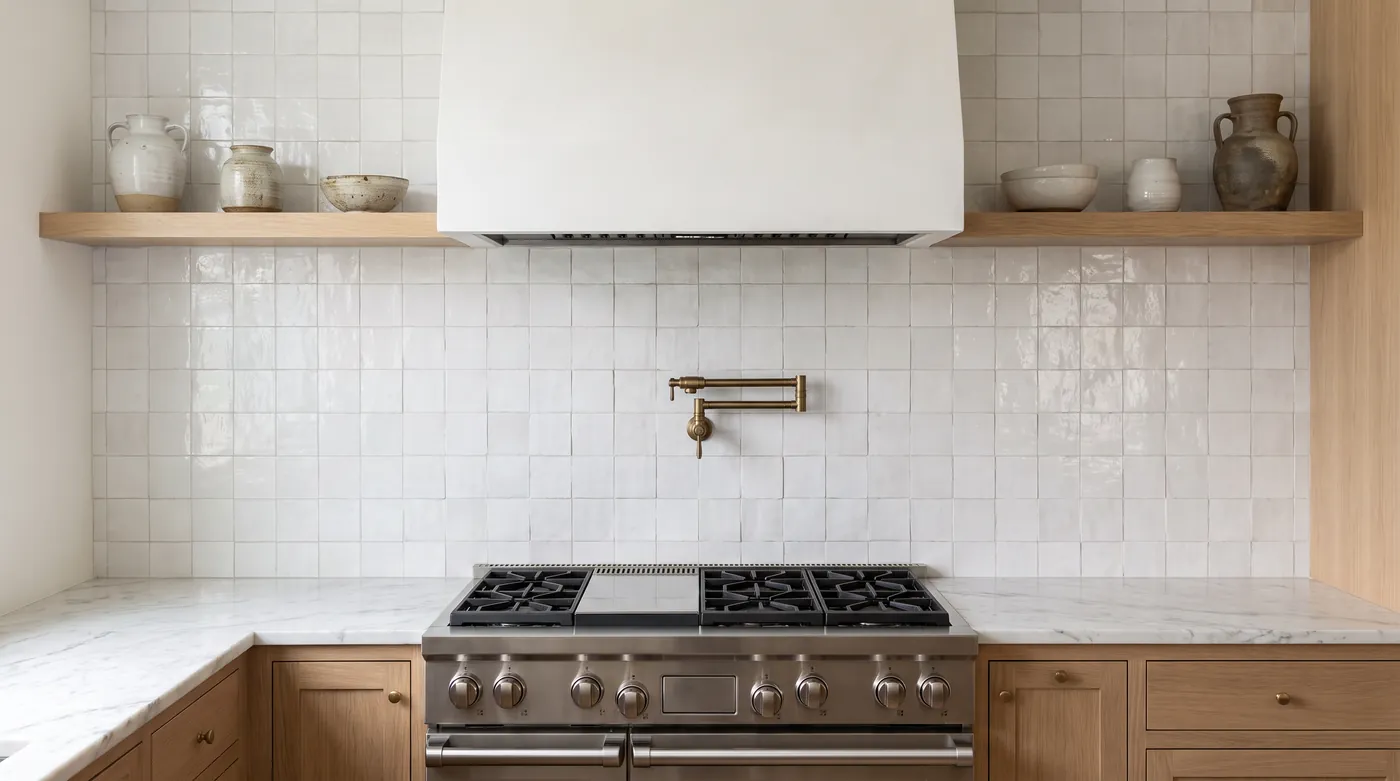
The backsplash is a small area that everyone looks at. It sits at eye level, between the counters and the upper cabinets, and it is where the lines of the kitchen either meet cleanly or do not. A tile cut to a sliver at the end of a run, an outlet that lands half on a grout joint, or a pattern that drifts off center behind the range is the kind of thing you notice every morning.
Many kitchens in Franklin and Brentwood still have what the builder left: a short strip of speckled granite along the wall with painted drywall above it, or small tumbled stone tile with wide grout lines. Often a backsplash is the last piece of a countertop project, and sometimes it is the only thing a good kitchen needs. Either way, we treat it as a layout problem first. The tile is drawn on the wall elevations before it is ordered, so you see where every full tile, cut, and outlet will fall.
Glazed ceramic and porcelain are the workhorses. They do not stain, they need no sealing, and they come in everything from a plain three by six subway tile to large format panels. Handmade tile, including zellige, has uneven edges and varied glaze that give a wall depth. It also varies from piece to piece, so it is set tight and accepted as irregular. Marble tile is quiet and classic behind a range in a traditional Franklin home, but it etches and can stain, so it has to be sealed and lived with honestly.
A full height slab backsplash uses the same quartz, quartzite, or porcelain as the countertop and runs it up the wall with no grout. It is the cleanest look and the easiest to wipe down. It is templated with the counters after the cabinets are set, and outlets have to be planned early, because every cutout is made in stone. Many homeowners move outlets to a strip under the upper cabinets to keep the slab uninterrupted.
The details decide how finished it looks. Grout color changes the whole wall: a matching grout makes the tile look like one surface, and a contrasting grout draws the pattern. Narrow joints with a stain resistant grout are easier to keep clean, which helps near the sink, where Middle Tennessee’s moderately hard water leaves scale. Exposed edges need a plan too, whether that is a matching bullnose, a mitered return, a slim metal profile from lines like Schluter, or ending the tile where a cabinet side covers it. Behind the range, we set the hood height before the layout is drawn, so the pattern is centered on the part of the wall you will see.
Once the layout and tile are approved, you receive a fixed written price before work begins. The only changes are ones you ask for, priced in writing first.
A backsplash goes up quickly when the thinking is done first. Book a kitchen consultation and we will measure your walls, look at samples against your counters, and draw a layout for you to approve. Or call (615) 555-0100.
After. The countertop is the base the tile sits on, so stone is installed first and the tile is set down to it with a small caulked joint where the two meet. If the backsplash is a full height slab of the same stone as the counters, it is templated along with them, after the cabinets are installed, and set by the stone fabricator. Either way, cabinets come first, counters second, backsplash third.
It is possible but rarely the right choice. Tiling over old tile adds thickness, which leaves outlets recessed and makes the edge at the end of the run look heavy. We usually remove the old tile. In many Franklin kitchens that pulls the paper face off the drywall, so we patch or replace that section of drywall and start from a flat wall. A flat wall is what makes a tile job look good.
In most cases, yes. Many builder kitchens in Franklin and Brentwood have a short strip of granite along the wall with painted drywall above it. Tiling above that strip leaves a visible ledge and dates the kitchen. The strip can usually be cut free and removed without damaging the countertop, and then tile runs from the counter to the cabinets. We check how it was attached before we promise a clean removal.
The fewer and narrower the grout joints, the easier the cleaning. A full height slab of quartz, quartzite, or porcelain has no grout at all. Large format porcelain tile has very little. Glazed ceramic wipes clean, and a stain resistant grout helps behind the range. Natural stone and handmade tile need more care, and marble will etch from acids like lemon juice and tomato sauce. We will tell you what each choice asks of you.
Tile work alone is cosmetic and often does not need a building permit. If the project includes adding or moving outlets, new circuits for under cabinet lighting, or a relocated range hood vent, those parts typically do. Requirements differ between the City of Franklin, the City of Brentwood, and unincorporated Williamson County. We confirm what applies to your address and pull the permits the job requires.
Full kitchen renovations for Franklin homes, drawn and approved first and priced in writing before any demolition.
Learn moreSemi custom and custom cabinets for Franklin kitchens, drawn to your room and on site before demolition starts.
Learn moreQuartz, quartzite, granite, marble, and soapstone countertops for Franklin kitchens, templated after the cabinets are set.
Learn moreCall (615) 555-0100 or request your free quote online. We serve Franklin, Brentwood, and Williamson County.