
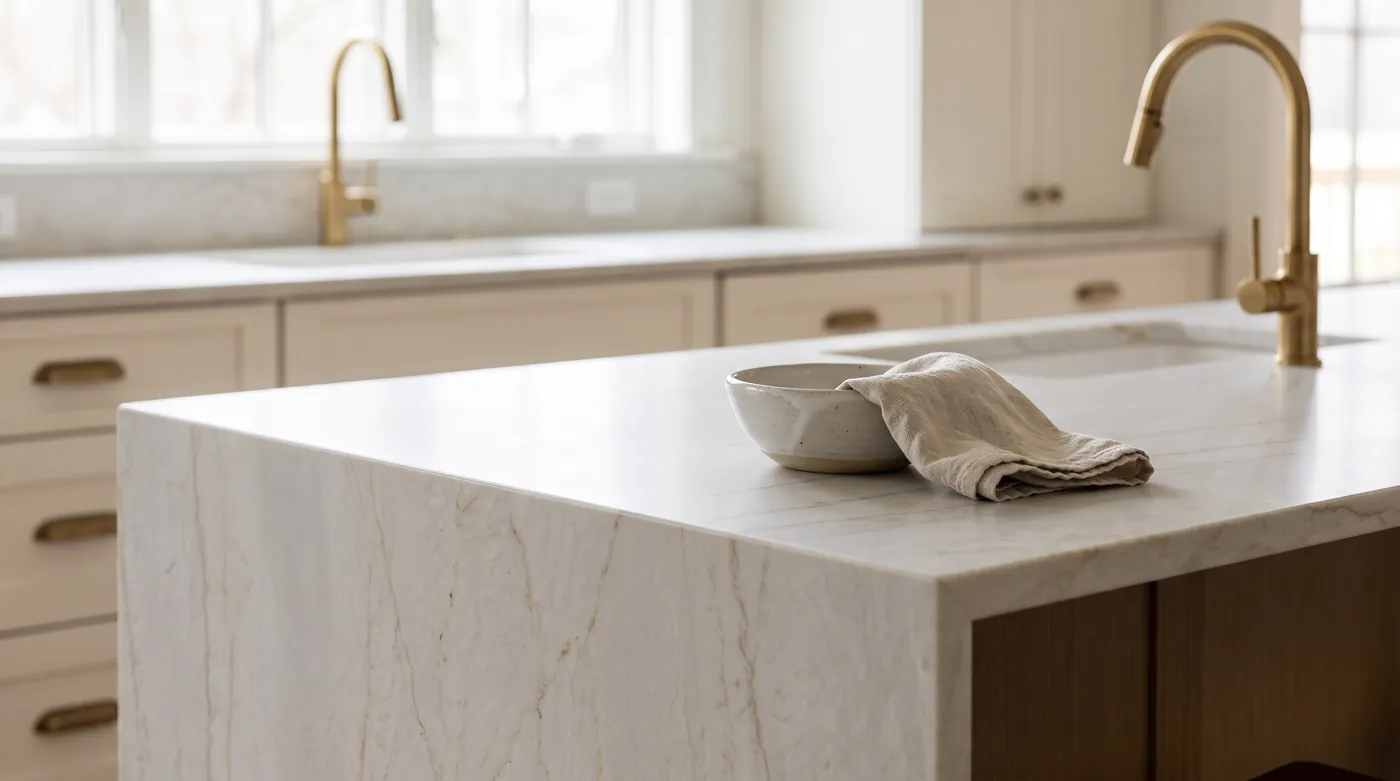
The countertop is the surface you touch more than any other in the house. It takes hot pans, knife slips, spilled coffee, and school projects, and it sits at eye level from every seat in the room. Choosing it well means being honest about how you cook and how much upkeep you will actually do.
In Franklin and Brentwood, the counters we replace are usually one of three things: tile with grout lines that never come clean, laminate that has lifted at the seams, or the speckled brown and gold granite that went into nearly every builder home here in the early 2000s. That granite is often still sound. It simply sets the color of the whole room, and it fights every cabinet color you might want to change to. A new top is also the moment to fix what the old one worked around, such as a two level bar, a drop in sink with a caulk line that collects grime, or a seam in the wrong place.
If the cabinets are also near the end of their life, it is worth deciding on them first. Stone is cut to fit the boxes beneath it and usually cannot be reused when those boxes change. Our kitchen cabinets page covers that decision.
Quartz is engineered stone. It is consistent from sample to slab, does not need sealing, and resists most stains, which is why it suits so many busy households. Its limit is heat, since the resin can mark under a hot pan, so trivets matter. Quartzite is natural and is often confused with quartz. It is hard, tolerates heat, and comes in soft whites and grays with real veining, and it needs sealing. Granite is durable and forgiving, and the current selections are much quieter than the speckled stone of the builder era.
Marble is the choice people argue about. It etches when acid touches it and it stains if spills sit, and no sealer fully prevents that. A honed finish hides the etching better than a polished one. Some homeowners love the patina a marble top takes on with use, especially in the older homes around downtown Franklin. If you want the look without the upkeep, a quiet quartzite or a marble patterned quartz is the honest alternative. Soapstone is soft, dark, and unbothered by heat or acid, and it scratches in a way that can be sanded out. Porcelain slab is thin, hard, and nearly stain proof, with printed patterns and more limited edge options.
Finish and edge change the result as much as the stone. Polished surfaces show color and depth. Honed and leathered surfaces hide fingerprints and water spots, which is useful with our moderately hard water. A simple eased edge suits most kitchens. A mitered edge makes an island top read thicker without the weight. Slab size decides where seams fall, so a large kitchen island should be planned with the slab in mind. The wall above the counter is chosen next, and our kitchen backsplash and tile page covers that.
Every countertop project gets a fixed written price after the design is approved. The only changes are ones you ask for, priced in writing first.
A slab looks different in your kitchen than it does on a screen, and it is worth seeing before you decide. Book a kitchen consultation and we will measure your counters, bring samples, and plan a visit to the stone yard. Or call (615) 555-0100.
Quartz is engineered. It is made from ground stone bound with resin, so the pattern is consistent and it never needs sealing, but a hot pan set directly on it can mark the resin. Quartzite is natural stone cut from a quarry. It is very hard, handles heat well, and has veining that no factory repeats, but it needs to be sealed. Both are good choices. The right one depends on how you cook.
For most busy households, quartz or a dense quartzite. Quartz resists stains and needs no sealing. Quartzite stands up to heat and scratching and only asks for periodic sealing. Granite is also durable and forgiving. Marble is the one to think hard about, because lemon juice, wine, and tomato sauce will etch it. Some people love that worn look. Others regret it within a month.
Yes, when the cabinets are sound, level, and staying where they are. We check that the boxes can carry the weight of stone, that the layout is not about to change, and that the sink base is in good condition. A new countertop usually means a new sink, faucet, and backsplash as well, since the old tile rarely survives removal. We plan those together so the finished edges line up.
Countertops are made to fit, so they cannot be cut until the cabinets are installed and a template is made. After the template, fabrication typically takes a short period that varies with the shop and the material. We build that gap into your written schedule and plan the plumbing reconnection and backsplash to follow right behind the installation, so the kitchen is back in use as soon as possible.
It can. Middle Tennessee water is moderately hard because of the limestone it moves through, and it leaves mineral scale around faucets and sink edges. On polished dark stone and on marble, that scale shows more and takes more care to remove without harming the surface. It is one reason we talk about finish, sink style, and faucet placement at the same time as the stone itself.
Full kitchen renovations for Franklin homes, drawn and approved first and priced in writing before any demolition.
Learn moreSemi custom and custom cabinets for Franklin kitchens, drawn to your room and on site before demolition starts.
Learn moreTile and slab backsplashes for Franklin kitchens, laid out on paper first so every cut and outlet lands where it should.
Learn moreCall (615) 555-0100 or request your free quote online. We serve Franklin, Brentwood, and Williamson County.